
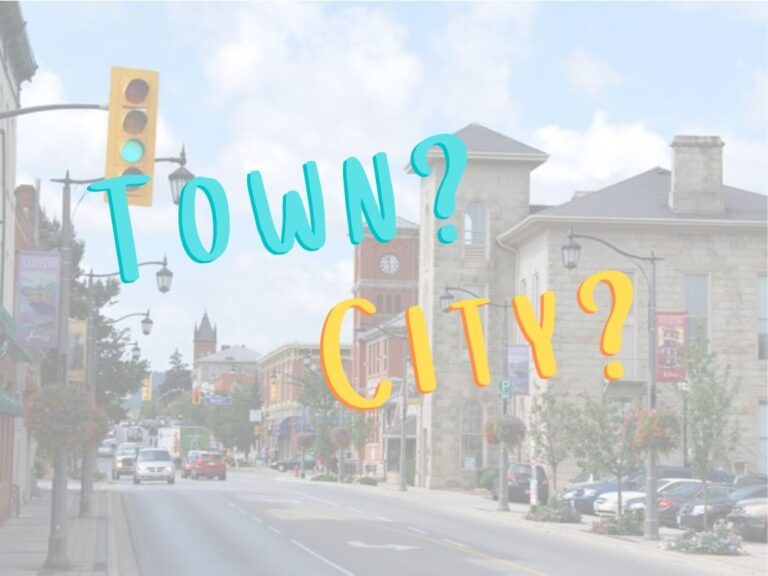
Is Milton a town or a city? Milton, Ontario is officially a town as of 2026. While Milton’s population has grown to over 145,000 residents — well beyond the size of many Canadian cities — it has not changed its legal designation. The Town of Milton remains the official municipal name, governed by a town council under the same incorporation that took effect in 1857.
This page answers the most common questions families ask before moving to Milton — including why a fast-growing community keeps its town status, what the difference between a town and a city actually means in Ontario, and what’s next for Milton’s classification.
Last updated: June 2026
Why is Milton still a town if it’s so big?
In Ontario, the difference between a “town” and a “city” is not based on population. Many Ontario municipalities have populations larger than smaller cities but choose to remain towns for governance, tradition, or community-identity reasons.
Milton’s status as a town is a legal designation under the Municipal Act, not a measurement. The Town of Milton has chosen to retain its status because:
- Community identity. Milton has positioned itself as a town with a strong sense of place — local businesses, family-focused growth, walkable neighbourhoods, and a connection to its agricultural roots.
- Governance continuity. Changing from town to city requires council and provincial approvals, plus updates to bylaws, signage, contracts, and provincial filings.
- No practical advantage. A town and a city in Ontario operate under the same Municipal Act, with the same powers and responsibilities. The change would be largely symbolic.
This is the same reason places like the Town of Oakville (population 213,000+) and the Town of Whitby (population 138,000+) have remained towns despite being larger than some Ontario cities.
What is the population of Milton, Ontario in 2026?
As of the most recent estimates, Milton’s population is approximately 145,000 residents, up from 132,979 at the 2021 census. Milton is one of the fastest-growing communities in Canada, with new construction continuing across Boyne, Walker, Cobban, Ford, and the Education Village expansion.
For context:
- 2001 census: 31,471
- 2011 census: 84,362
- 2021 census: 132,979
- 2026 estimate: ~145,000
That’s growth of more than 360% in 25 years — yet Milton remains a town.
When was Milton incorporated?
Milton was officially incorporated as a town in 1857, founded around a sawmill operated by Jasper Martin. The town has continuously held its town designation for more than 165 years.
What year did Milton become a city?
Milton has not become a city. As of 2026, Milton is still officially the Town of Milton — the same designation it has held since its incorporation in 1857. Despite repeated assumptions online that Milton “became a city” in 2023 or 2024, no such change has happened. There is no formal motion before council, no provincial approval, and no official municipal renaming. If you’ve seen content claiming otherwise, it’s incorrect.
The confusion is understandable. Milton’s population (~145,000) is larger than several Ontario cities, and the Greater Toronto Area’s growth narrative makes “city” feel like the natural label. But in Ontario, town vs. city is a legal designation — not a population threshold — and Milton has chosen to keep its town status.
Will Milton ever become a city?
There is no official plan as of 2026 for Milton to change its status from town to city. The conversation has come up from time to time in council discussions and community forums, but no formal motion has been brought forward to make the change.
If Milton ever does transition, it would require:
- A formal motion approved by Milton Town Council
- Provincial approval through the Ontario Ministry of Municipal Affairs
- Updates to all official municipal branding, contracts, and legal documents
For families looking at homes in Milton, this is not a meaningful factor in property value, services, or community life. Town vs. city is a label — what matters is the schools, neighbourhoods, infrastructure, and lifestyle that come with the area.
Town vs. city: what’s the actual difference in Ontario?
In Ontario, the legal difference between a town and a city is almost nothing. Both are categorized as lower-tier municipalities under the Municipal Act and have:
- The same powers under provincial law
- The same ability to levy property taxes
- The same responsibility for local services (parks, roads, libraries, planning)
- Equal access to provincial and federal funding programs
The historical distinction was based on size and importance — cities were larger commercial hubs, towns were smaller. Today, that distinction is mostly symbolic and tied to local identity rather than legal authority.
Is Milton growing fast enough to become a city?
By population, Milton is already larger than many Ontario cities. Cornwall is a city with a population of about 47,000. North Bay is a city with about 51,000. Milton’s 145,000 residents would rank it among the larger municipalities in the province.
But size alone doesn’t trigger a status change. Milton has chosen to keep its identity as a growing town rather than reclassify, and that’s reflected in everything from civic branding (“Town of Milton”) to community marketing.
What does this mean if I’m buying a home in Milton?
Practically — nothing. Whether Milton is officially a town or a city makes no difference to:
- Property taxes (both are governed by the same provincial framework)
- Mortgage approvals
- School zone designations
- Real estate values
- Future resale potential
What does matter when buying in Milton is which neighbourhood you’re choosing. Milton’s neighbourhoods vary significantly in price, age, school catchment, and lifestyle — far more than the town/city debate would ever affect your decision.
If you’re considering a move to Milton or want a no-pressure conversation about which neighbourhood fits your family, book a free Buyer Clarity Call. We’ve helped 250+ Halton families navigate this market over 15+ years — and we’d be happy to help you, too.
Frequently Asked Questions
Is Milton, Ontario a city? No. Milton is officially a town as of 2026, despite having a population over 145,000.
Why isn’t Milton called a city if it has more people than other cities? Ontario doesn’t tie the town/city designation to population. Milton has chosen to remain a town for community-identity and governance-continuity reasons.
When did Milton become a town? Milton was incorporated as a town in 1857.
What’s the population of Milton in 2026? Approximately 145,000 residents.
Will Milton become a city soon? There is no formal plan to change Milton’s designation as of 2026.
Does it matter for buying a home if Milton is a town or city? No. The town/city distinction has no practical effect on home buying, property taxes, or real estate values.
Andrew and Lisa Roach are licensed REALTORS® with the Roach Family Real Estate Team in Milton, Ontario. They’ve helped over 250 Halton families buy and sell homes since 2010. Have a question about Milton? Reach out — they’d love to help.
