
If you’re a first-time home buyer in Canada—especially here in Ontario—in your 20s to 40s trying to make sense of all the steps, taxes, fees, incentives, and down payment rules, this guide is for you. My goal is to give you a clear, simple roadmap so you can stop guessing and start planning your first home with confidence. Even if you’re a first-time buyer “again”.
Free for First-Time Buyers
Download the First-Time Buyer Starter Pack
Everything you need to go from “I hope we can buy” to “we got the keys!”
You’ll get:
- Home Buying Secrets Revealed – In-depth roadmap from saving plan to keys in hand
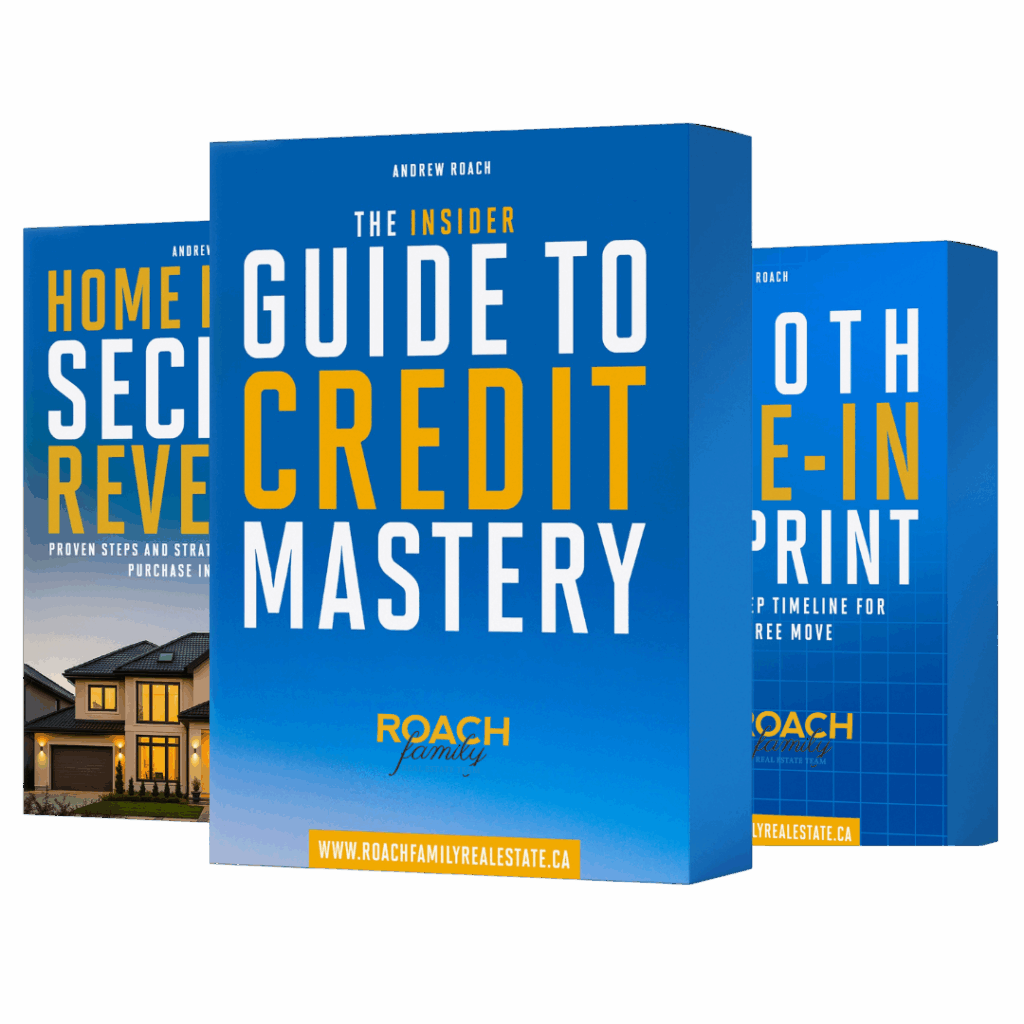
- Credit Mastery Guide – Simple playbook on how to build or fix credit before the bank judges you
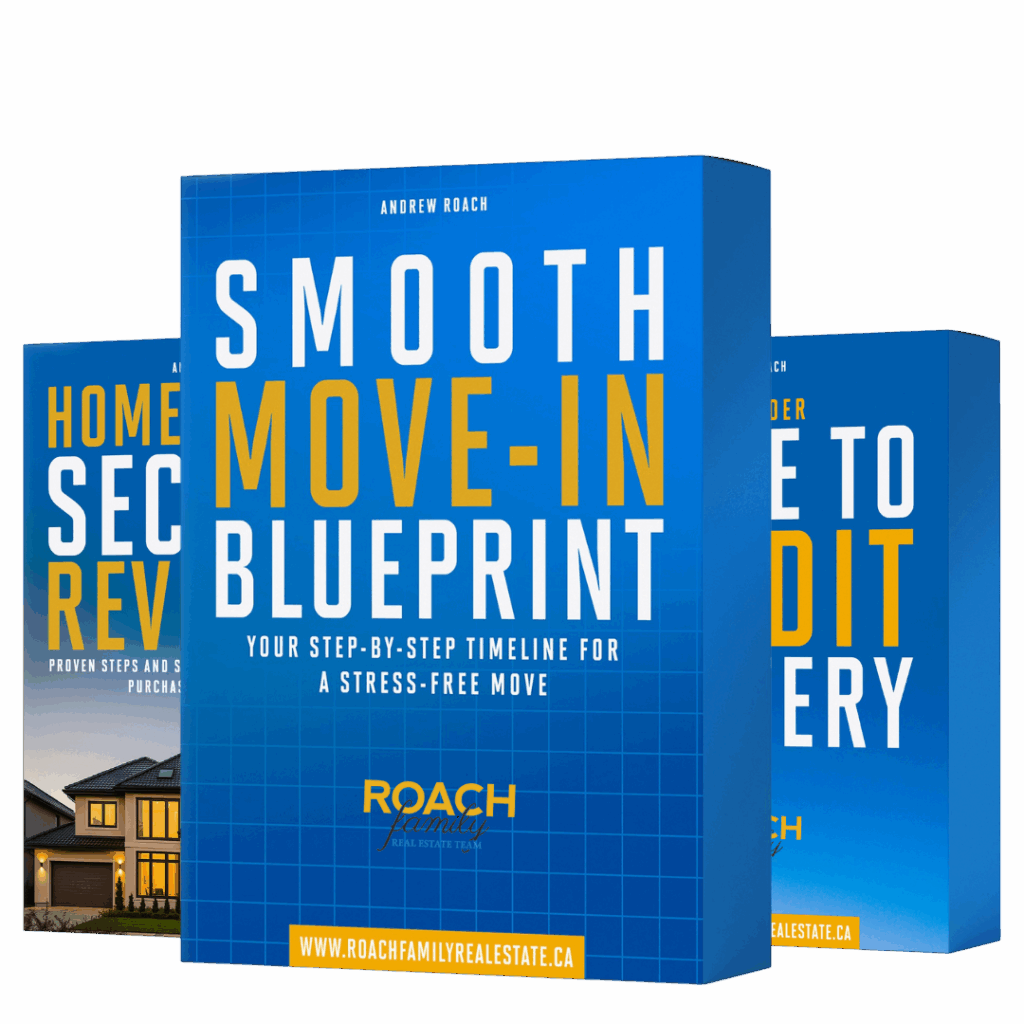
- Smooth Move-In Blueprint – Know exactly what to do from accepted offer to unpacking the last box
Sent instantly. No spam, ever.

If we haven’t met yet, I’m Andrew Roach. I’m a homeowner, multi-property investor, husband, father of three, and I’ve helped more than 250 families navigate the often chaotic process of buying and selling homes.
What I’m going to show you here is how the home buying process works for first-time buyers in Canada, how we set our clients up for success, and how that can save you time, stress, and a lot of money.
We do this through educating our clients based on 15+ years of experience and a deep understanding of the real estate industry in Ontario.
By the time you’ve read this through, you’ll know:
- who actually qualifies as a first-time home buyer,
- how much you need for a down payment,
- which programs still exist and are worth paying attention to,
- and you’ll have a simple roadmap for going from nervous and unsure to holding the keys to your first home.
Are You Actually a “First-Time Home Buyer” in Canada?
In Canada, to qualify as a first-time home buyer you and your spouse must not have owned and lived in a home anytime in the current calendar year, or the preceding four calendar years. To go a step further, ownership is defined as whole ownership as well as joint ownership. So, if either yourself or your spouse owns or owned a home you lived in over the current or preceding four years, you would not qualify. Additionally, if either of you jointly-owned a home either of you lived in, you would not qualify. Finally, a first-time home buyer must intend to live in the home they anticipate buying. Meaning, an investment property will not qualify. Since rules change often, it’s wise to check official government sources on the Home Buyers Plan.
Note: if you’re separated and have lived apart from a spouse/partner for 90+ days, you may regain first-time status.
Quick Checklist
✔ Canadian resident, 18+
✔ Haven’t owned/occupied a home in current or last 4 calendar years
✔ Intend to live in the home as your principal residence
Want a full breakdown of who qualifies and how the rules apply to your situation? See our complete guide to first-time home buyer qualifications in Ontario →
How Much Down Payment Do First-Time Home Buyers Need?
The minimum amount for a down payment can be a bit confusing at times. Mostly because of the way it’s often explained, but also because the older generation got comfortable with one standard downpayment rule. Gone are the days of a blanket percentage.
As of February 15th, 2016 and December 15th, 2024 the rules got a bit more complicated, but not much. These are minimum down payments — not exact amounts. So if you have a large down payment you can certainly use more.
In short, the minimum down payment on any purchase price of $500,000 or below is 5%. Next, if the home you’re buying costs more than $500,000 then any portion above and up to $1,500,000 is subject to 10% down payment on that portion alone, plus the 5% from the first $500,000. Finally, any home that costs $1,500,000 or more is subject to a blanket 20% on the entire sum.
For example, an $800,000 home would break down like this:
- First $500,000 × 5% = $25,000.00
- Remaining $300,000 × 10% = $30,000.00
- Total minimum down payment required = $55,000
Another example, a $1,300,000 home:
- First $500,000 × 5% = $25,000.00
- Remaining $800,000 × 10% = $80,000.00
- Total minimum down payment required = $105,000
Finally, a $1,600,000 home would have a flat 20% down payment applied for the entire purchase price — equalling $320,000 minimum down payment.
Note: Can you put more than the minimum? Yes! What happens if you put 20% or more down? You don’t pay Mortgage Default Insurance (often called CMHC). If you put less than 20% down you will pay a tiered premium based on your down payment. The less you put down, the higher the insurance premiums. This is added to your mortgage balance so not required up front, except the PST on the insurance premium is due with your down payment.
How Much Can You Afford Monthly?
Figuring out how much you can afford each month is both easy and hard.
On one hand, you probably already have a good sense of how much money you have left over after your regular bills. On the other hand, banks and lenders look at things a bit differently. Because everyone’s finances are unique, lenders use standard “boxes” called Debt Service Ratios to make things simpler.
They use two main calculations:
- Gross Debt Service (GDS) – usually capped around 39%
- Total Debt Service (TDS) – usually capped around 44%
What does this mean?
- GDS is your housing costs: mortgage payment + property taxes + heat + (if applicable) 50% of condo fees. Lenders generally want this to be no more than ~39% of your gross (before-tax) household income.
- TDS is your GDS plus all your other debts: things like student loan payments, car payments, credit card/line of credit payments, etc. Lenders generally want this to be no more than ~44% of your gross income.
The higher your non-mortgage debts are, the less room you have left inside that 39% GDS limit for housing costs.
Example 1 – Single Buyer
A single buyer earns $100,000/year before tax and has: car payment $300/mo, student loan $500/mo, credit card $150/mo.
- Monthly gross income: $100,000 ÷ 12 = $8,333/mo
- Total monthly debts: $300 + $500 + $150 = $950/mo (≈11.4% of income)
- At 44% TDS cap: $8,333 × 44% = $3,666 total allowed
- $3,666 – $950 (other debts) = $2,716/mo left for housing costs (≈32% GDS)
If their non-mortgage debts were only $300/mo, they’d have close to the full 39% GDS (~$3,250/mo) available for housing.
Example 2 – Couple
Same $950/mo in debts, but two buyers earning $80,000 each ($160,000 combined).
- Monthly gross income: $13,333/mo
- Debts as % of income: ≈7%
- At 44% TDS: $5,866 total allowed – $950 debts = $4,916/mo for housing (≈37% GDS)
If they reduce other debt payments to $650/mo, they can get close to the full 39% GDS for housing.
Note: These ratios don’t mean you should spend up to the maximum. They’re just the guidelines lenders use to decide whether you qualify. Many families feel more comfortable choosing a payment that’s well below those limits.
Worried about credit or debt?
The Starter Pack includes our Credit Mastery Guide
Inside, you’ll discover:
- The simple score ranges that show exactly how lenders see you
- The 5 factors that actually move your score in Canada
- The one thing you must never do 90 days before you apply
- How to repair bruised credit from missed payments, consumer proposals, or even bankruptcy
- A simple, repeatable routine to keep your score climbing while you save
Programs & Incentives for First-Time Buyers (What Still Exists)
There are several federal and provincial programs available to first-time buyers in Ontario. Some are substantial (thousands of dollars in your pocket), some are modest tax savings, and one has been discontinued. Here’s a clear breakdown. For a full deep-dive into each, see our complete guide to Ontario first-time home buyer incentives and programs →
First Home Savings Account (FHSA)
A First Home Savings Account (FHSA) is a special registered account that combines some of the best parts of an RRSP and a TFSA for first-time home buyers.
Like an RRSP, your contributions are tax-deductible. That means if you put $8,000 into your FHSA this year, you can reduce your taxable income by $8,000 when you file your taxes.
Like a TFSA, your money can grow tax-free inside the account, and if you use it to buy a qualifying first home, your withdrawal (contributions + growth) is not taxed.
There are a few key differences from a regular TFSA:
- Use of funds: FHSA money is meant to be used for a qualifying home purchase. If you don’t end up buying a home, you can transfer the balance to an RRSP or RRIF tax-free, without using up RRSP contribution room, or withdraw it as taxable income.
- Limits: A TFSA has an annual limit but no lifetime cap. An FHSA has an $8,000/year contribution limit and a $40,000 lifetime contribution limit (not including growth). The growth on your investments does not count toward that $40,000.
- Time limit: An FHSA can only stay open for up to 15 years (or until the end of the year you turn 71, or the year after you use it to buy a home), so it’s designed as a medium-term “save for your first place” tool, not a forever account.
And while $40,000 on its own won’t buy you a home in the GTA, it can still make a real difference to your down payment—especially if you’re buying with a partner.
If both you and your spouse/partner open an FHSA and each contribute $8,000 per year for 5 years, you could together build up $80,000 in contributions, plus any investment growth, to put toward your first home.
RRSP Home Buyers’ Plan (HBP)
The RRSP Home Buyers’ Plan (HBP) lets eligible first-time home buyers withdraw up to $60,000 from their RRSPs to buy or build a qualifying home without paying tax at the time of withdrawal.
Normally, RRSP withdrawals are taxable income. With the HBP, you can pull money out of your RRSP to use toward your home and avoid tax up front, as long as you follow the repayment rules. Think of it as an interest-free loan from your future self.
Key rules to know
- Who it’s for: Generally, you must qualify as a first-time home buyer under CRA’s definition (you and your spouse/partner haven’t owned and lived in a home as your principal residence in the last few years).
- How much you can withdraw: You can withdraw up to $60,000 from your RRSP. Your spouse or partner can also withdraw up to $60,000 from their own RRSP. Together, that can be as much as $120,000 toward your purchase.
- The 90-day rule: RRSP contributions made in the 89 days before your HBP withdrawal may not be fully deductible. If you’re planning to “top up” your RRSP just to use the HBP, aim to have that money sitting in your RRSP for at least 90 days before you withdraw.
Repayment: how paying it back works
- You have up to 15 years to repay what you withdrew back into your RRSP.
- In most cases, repayments start the second year after the year you make your withdrawal.
- CRA sets a minimum yearly repayment: take your total HBP withdrawal and divide it by 15.
If you pay more than the minimum in a given year, your future minimums go down because they’re recalculated based on the remaining balance and years left.
If you pay less than the minimum, the shortfall gets added to your income for that year and is taxed like a normal RRSP withdrawal.
HBP Repayment Example
You withdraw $30,000 from your RRSP under the HBP. Your initial minimum yearly repayment: $30,000 ÷ 15 = $2,000/year.
- Years 1–4: pay $2,000/year → $8,000 total repaid, $22,000 remaining
- Year 5: pay $10,000 → $18,000 total repaid, $12,000 remaining
- 10 years left: new minimum = $12,000 ÷ 10 = $1,200/year
By making a bigger payment in year 5, you reduced your required payments in future years.
First-Time Home Buyers’ Tax Credit (HBTC)
The First-Time Home Buyers’ Tax Credit (HBTC) is a federal non-refundable tax credit you claim at tax time in the year you buy your home.
On line 31270 of your tax return, eligible buyers can claim up to $10,000 (the “Home Buyers’ Amount”), which works out to up to $1,500 off your federal tax bill.
Unlike some of the other programs, this credit is for the home, not for each person. That means one spouse/partner can claim the full $10,000 and the other $0, or you can split it between you — but the total claimed for that home can’t be more than $10,000.
Because this is a tax credit, it only reduces the federal tax you owe. If you owe less than $1,500 in federal tax, the credit is limited to the amount owing. It doesn’t create a refund beyond what you actually owe.
Land Transfer Tax Rebates
In Ontario, a tax is charged when a home is transferred to a new owner — it’s called Land Transfer Tax (LTT). It’s calculated using brackets: you pay a lower percentage on the first slice of the purchase price, a higher percentage on the next slice, and so on. The more expensive the home, the more LTT you’ll pay in total.
Ontario is one of a few provinces that offers a rebate for first-time buyers. The provincial rebate can cover the full LTT amount, up to $4,000. Any LTT above $4,000 must be paid by the buyer.
- If you’re buying a home for $368,000 or less in Ontario and you qualify as a first-time buyer, your entire provincial LTT is rebated.
- If you’re buying a home for more than $368,000, you still get the full $4,000 rebate, but you’ll owe any LTT over and above that amount.
For buyers in Toronto, there’s an extra wrinkle: Toronto charges its own municipal LTT in addition to Ontario’s. The Toronto first-time buyer rebate goes up to $4,475, which covers the full Toronto LTT on homes priced up to $400,000. Above $400,000, you’ll get the maximum $4,475 municipal rebate, but still pay any remaining municipal LTT.
In practice, your lawyer usually applies for these rebates on your behalf as part of your closing costs. See the full guide with calculator: How much is Ontario land transfer tax? →
First-Time Home Buyer Incentive (FTHBI) – Now Discontinued
The First-Time Home Buyer Incentive was a shared-equity program where the government chipped in 5–10% of your purchase price in exchange for the same percentage of your home’s value when you sold or refinanced.
It had mixed reviews and came with significant backlash — many professionals saw this as the government taking an ownership stake in people’s homes. It stopped accepting new applications as of March 21, 2024, with no new approvals after March 31, 2024.
How These Programs Can Work Together
Here’s a simple example of how this could look if you stacked everything as a first-time buyer.
Let’s say you and your partner are buying your first home for around $800,000. Over a few years you’ve each been:
- Maxing your FHSA: You each contribute up to $40,000. Together, that’s $80,000 (plus any investment growth) you can pull out tax-free for your down payment.
- Using the RRSP Home Buyers’ Plan (HBP): You each withdraw $30,000 from your RRSPs. That’s another $60,000 you can use now, and repay slowly over up to 15 years.
$80,000 (FHSA) + $60,000 (HBP) = $140,000 toward your down payment and closing costs.
Then the smaller pieces kick in:
- As first-time buyers in Ontario, you can get up to $4,000 back on your provincial Land Transfer Tax.
- At tax time, you can also claim the First-Time Home Buyers’ Tax Credit (HBTC) for up to $1,500 off your federal tax bill.
- If you’re buying in Toronto, there’s a separate Toronto LTT rebate on top of all this.
None of this magically makes homes “cheap” again — but when you layer FHSA + HBP + the tax credit + land transfer tax rebates, it can easily mean tens of thousands of dollars more going toward your first home instead of to taxes and interest.
What Extra Costs Should First-Time Buyers Plan For?
Extra costs can come up as a surprise, which can be painful. It’s best to know exactly what to expect up front to reduce stress and make informed decisions.
Here’s a list of costs you can expect to pay along the way. I’ll put a very rough estimate beside some of them to give you an idea, but this is by no means exact, nor should it be relied on. It’s for informational purposes only and you should verify with each independent professional.
- Land transfer tax (provincial + possible municipal)
- Legal fees & disbursements – approximately $1,500–$1,800 for purchase, depending on the lawyer
- Title insurance – approximately $500 but depends on purchase amount
- Home inspection / status certificate (for condos) – $600 for house, less for condo
- Appraisal (if charged) – $300
- Property tax adjustments – 100% dependent on if the seller pre-paid their taxes. Set aside $2,000 and you probably won’t need it.
- Home insurance – ongoing monthly charge, not one time. Approx. $100–$150/month
- Moving costs, small renos, furniture – DIY or movers? How small are the renos? What furniture are you buying?
Rule of thumb: budget 3–4% of purchase price for closing + move-in costs
Want the full breakdown with exact numbers? See our complete guide to closing costs in Ontario →
Common Mistakes First-Time Buyers Make (and How to Avoid Them)
Buying your first home is exciting — but it’s also really easy to get tripped up by a few common mistakes. Here are some of the big ones I see, and how to sidestep them.
1. Shopping before getting a solid pre-approval
Scrolling listings is fun, but going out and shopping for a home and falling in love before you’ve talked to a mortgage professional is risky. You might be looking at the wrong price range — or worse, find “the one” and then discover you can’t get approved for it.
What to do instead: Get a proper pre-approval in writing first, then shop with confidence inside that range.
2. Focusing only on the max price instead of monthly comfort
Lenders will often approve you for more than what feels comfortable month-to-month. Just because the bank says “you can go to $800,000” doesn’t mean you should.
What to do instead: Start with your ideal monthly payment (including property tax and utilities) and work backward from there. Your future self will thank you.
3. Ignoring closing costs
It’s easy to fixate on the down payment and forget everything else: land transfer tax, legal fees, home inspection, moving costs, etc. Those can add up to many thousands of dollars on top of your purchase price.
What to do instead: Build closing costs into your plan from day one so you’re not scrambling right before closing.
4. Stretching too far to “win” one particular house
Whether it’s bidding wars and low inventory or sellers asking too much in a down market, both can make it feel like “if we don’t get this one, we’ll never find another.” That’s when buyers overreach and end up house-poor.
What to do instead: Decide your true walk-away number before you offer — and stick to it. There will always be another house; there’s only one budget.
5. Not thinking about the next 5 years of life
Many first-time buyers we’ve worked with only think about where they are today, not what life may look like in a few years. Kids, schools, daycare, commute, aging parents — all of that can change what “good fit” means.
What to do instead: Ask, “Will this home still work for us in 5 years?” Think about bedrooms, yard, parking, and school catchments with your future self in mind.
Step-by-Step Roadmap: From “Thinking About It” to Keys
1. Get clear on your budget
Look at your household income, debts, and current savings. From there, work out a realistic monthly payment you’re comfortable with — not just what a bank might approve you for. Maybe you love spending time at home. You don’t go out much, don’t travel — it’s just not you. But maybe you hate being locked up and have to go out every night, weekends away and traveling could be a full-time job. Decide how much you need to be happy.
2. Use the FHSA and/or RRSP HBP (if they make sense for you)
If you qualify, start funneling your savings into a First Home Savings Account (FHSA) and/or set yourself up to use the RRSP Home Buyers’ Plan (HBP). These can give you real tax advantages and boost your down payment. Consider this: if you earn $80,000/year in Ontario, putting away 10% would save you nearly $2,400 in taxes, which could go into a TFSA or other tax umbrella.
3. Clean up your credit and debt
Pay down high-interest debt (credit cards, lines of credit) and avoid taking on new loans or “buy now, pay later” payments. A cleaner credit picture can mean a better approval and sometimes a better rate. Plus, as we illustrated above with the Debt Service Ratios, if you have low debt you can qualify for more home.
4. Choose your real estate agent
This is where you pick your guide. You want someone who:
- Is a full-time professional Realtor. Avoid people who treat the largest investment of your life as a side-hustle. There are over 75,000 agents in the GTA — most of them are part-time and will treat you as such.
- Will walk you through the process step-by-step
- Will tell you both the good and bad about every home
- Will protect you on things like conditions, inspections, and offer strategy
You should feel like you can ask “silly” questions and get straight answers. They should also have a very good working relationship with numerous mortgage brokers and banks, lawyers, and inspectors that they can recommend. But be careful if you only get one recommendation.
5. Talk to a mortgage professional & get pre-approved
Sit down with a mortgage broker or lender to review your numbers, compare fixed vs. variable rates, and get a pre-approval in writing — not just being prequalified. In a pre-approval you will provide all your supporting documents up front: your income, tax documents, savings and your credit will be pulled (don’t worry, one hit won’t ruin your credit). The only thing missing will be the home. That will give you a true pre-approval.
This tells you your top-end budget and will give you confidence when searching for and offering on a home.
6. Clarify your must-haves for daily life
Together with your agent, narrow down what really matters:
- Bedrooms, bathrooms, basement
- Commute time
- Yard size or nearby parks
- Garage
- Noise, storage, parking, etc.
This becomes your “must-have / nice-to-have / deal-breaker” list.
7. Start touring homes with your agent – online first, then in person
Begin by looking online: photos, floor plans, virtual tours, neighbourhood maps. Then we book in-person showings. We call this Window Shopping. We aren’t finding “the one” yet, but comparing online to in-person.
Once we have a great understanding of what we’re looking for and want to avoid, we then narrow into finding your new home.
8. Offer strategy & conditions
When you find “the one,” we’ll talk strategy:
- Price and how it compares to recent sales
- Conditions (financing, appraisal, home inspection, status certificate for condos, etc.)
- Timing for closing and any seller requests
The goal is to balance protecting you with making a competitive offer.
9. Firming up, lawyer review, and closing day plan
Once your offer is accepted:
- Your lender works on final approval and appraisal
- Your lawyer reviews the agreement, title, and closing costs
- You book movers, set up utilities, and plan your move-in day
On closing day, the keys are released once the funds and paperwork are all in place — then it’s officially your home.
Bonus inside the Starter Pack
The 60-Day Move-In Blueprint That Saves Your Sanity on Closing Day
When your offer’s accepted, the hard part shouldn’t be keeping a hundred tiny details in your head. Inside the Starter Pack you’ll get the Smooth Move-In Blueprint — a simple checklist that walks you through:
- Exactly what to do from 60 days before closing to 30 days after move-in
- The legal and money steps most people stress about — in plain language
- Who to call and when (movers, insurance, utilities, internet, mail forwarding)
- Move-day and first-week reminders most families forget
What Extra Costs Should First-Time Buyers Plan For?
Ready for Your First Home? Here’s What to Do Next
If you’ve made it this far, you’re already way ahead of most first-time buyers.
You now have a clearer picture of:
- Whether you’re likely to qualify as a first-time buyer
- Roughly how much you’ll need for a down payment and closing costs
- Which programs (FHSA, HBP, tax credits, rebates) you can actually use
- The steps between “thinking about it” and “we got the keys”
The next step is to pull all of this into a plan that fits your family, your budget, and your timeline.
What Our Clients Are Saying
★★★★★
“Lisa and Andrew are the most genuine and hardworking real estate agents we have ever met. Lisa helped us buy our first home a few years ago, and guided us through the whole process (we had no idea what we were doing). Our experience was so great that we decided to use them again to sell and buy a larger home for our growing family… I will most definitely be recommending them to my friends or family in the GTA.”
— Kass Bartlett
★★★★★
“Andrew, Lisa, and their team are wonderful to work with throughout the process of buying and now listing to sell my home. The services they provide are unmatched. Having the comfort knowing that I can message them at anytime with my many questions and being answered without hesitation… Thank you, Andrew and Lisa without you we would have not found our forever home.”
— Michelle Allen
★★★★★
“My wife and I were looking for a new home for our growing family. Our previous neighbour used Lisa and Andrew’s services to sell their home and came highly recommended… Overall, we had a very good experience with having Lisa and Andrew as our Realtors.”
— Eric St-Onge
★★★★★
“The RFRE Team are top notch! Professional, knowledgeable, personable and quick to reply to any inquiry you may have. I would highly recommend them to anyone looking to buy, sell or rent! You won’t be disappointed :)”
— Katie Christou
★★★★★
“Andrew and team are fantastic! When we told Andrew what we were looking for he didn’t hesitate, he did everything he could and helped us get everything inline! The timeline was tight and yet he made it happen! He answered our questions with honesty and as much detail possible. Everything was done with complete professionalism! I wouldn’t hesitate to recommend Andrew and his team!”
— Lisa Black
★★★★★
“Our agent, Andrew, was amazing. He was always available to answer our questions. He was also very knowledgeable about what a house was worth, and what locations were desirable to live in. I always felt bad about asking him to take us to see a house (often at the last minute) but it never bothered him. He was incredibly positive and professional all the time. I would recommend him and his team to anyone who was looking for quality service.”
— Gerry Schulze
Go Deeper — First-Time Buyer Guides
Free for First-Time Buyers
Not sure where to start? We made this for you.
The First-Time Buyer Starter Pack walks you through exactly what to expect — from getting pre-approved to making an offer. No jargon, no pressure. Just a clear picture of the process.
Get the Free Starter Pack →Sent instantly. No spam, ever.
Ready to Talk Through Your Situation?
Every buyer’s situation is different. The Buyer Clarity Call is a free 30-minute conversation to walk through your specific numbers, timeline, and questions — no pressure, no pitch.
Book a Free Buyer Clarity Call →